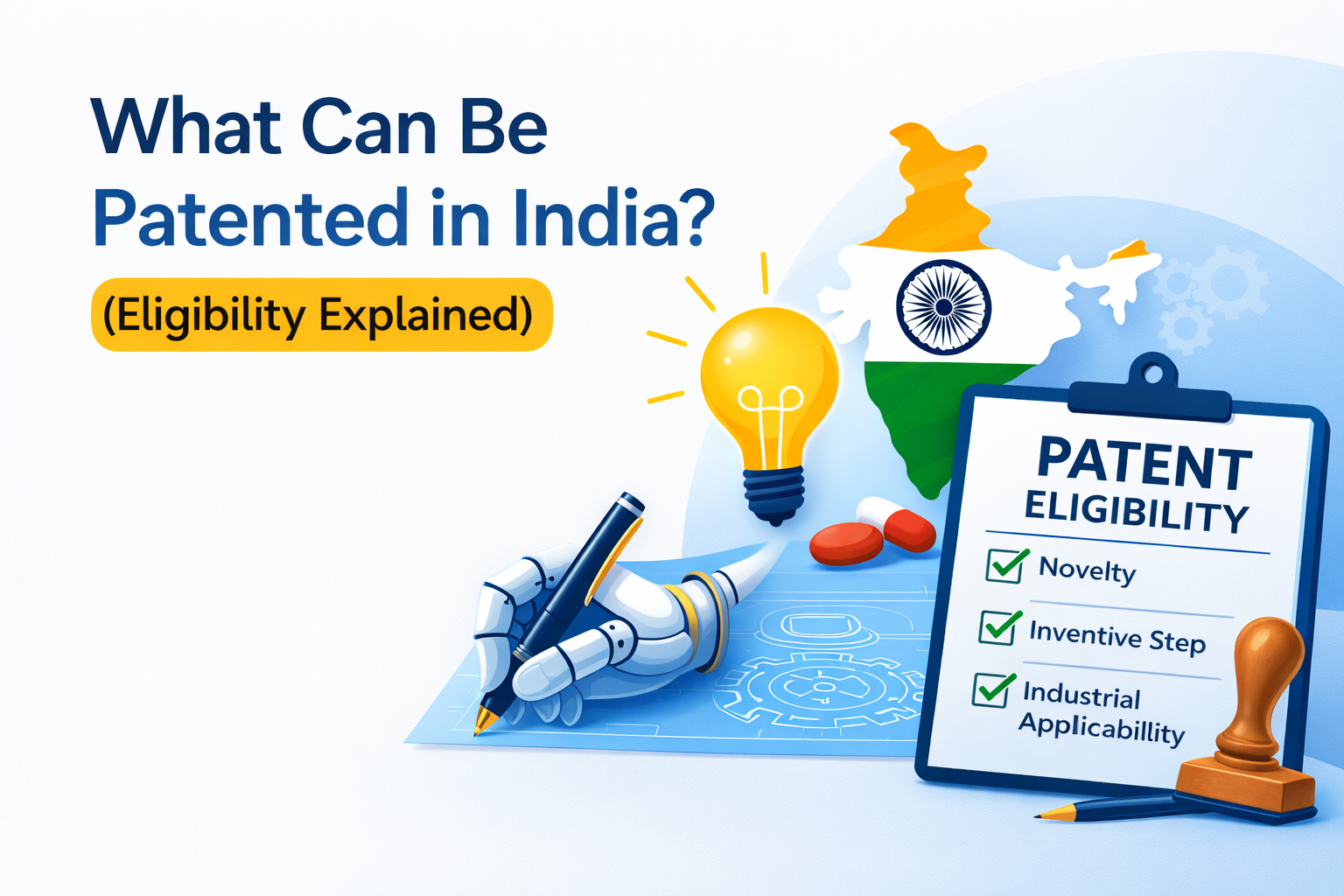
What Can Be Patented in India? (Eligibility Explained)
Innovation is growing rapidly in India. Startups, entrepreneurs, and inventors are constantly creating new technologies, products, and processes. But creating an invention is only the first step—protecting it legally is equally important.
This is where Patent Registration in India becomes essential.
Many innovators often ask questions like:
-
Can my idea be patented?
-
What are the eligibility rules for patents in India?
-
How do I protect my invention from being copied?
Understanding patent eligibility in India helps inventors know whether their invention qualifies for legal protection. This guide explains what can be patented in India, what cannot be patented, and how to start the patent filing process.
What is a Patent?
A patent is a legal right granted by the government that gives an inventor exclusive ownership of an invention for a certain period of time.
In India, patents are governed by the Patents Act, 1970 and administered by the Indian Patent Office.
Once a patent is granted:
-
The inventor gets exclusive rights to use the invention
-
Others cannot make, sell, or use the invention without permission
-
The patent holder can license or sell the patent
Patent Validity in India
A patent in India is valid for 20 years from the filing date.
After that, the invention becomes part of the public domain, meaning anyone can use it.
For startups and innovators, patent registration in India is a powerful way to protect intellectual property and maintain a competitive advantage.
What Inventions Can Be Patented in India?
Not every idea can be patented. To qualify for patent protection, the invention must meet specific patent eligibility criteria in India.
Generally, the following types of inventions can be patented:
1. New Products
If you have created a new product with unique functionality, it may be patentable.
Examples:
-
A new medical device
-
An innovative battery technology
-
A new electronic component
2. New Processes
A new method or manufacturing process can also be patented.
Examples:
-
A new method of manufacturing steel
-
A chemical production process
-
An improved food preservation technique
3. Improvements to Existing Technology
Even if the invention improves an existing product significantly, it may qualify for a patent.
Example:
-
A smartphone camera improvement
-
An improved AI algorithm
Understanding how to patent an idea in India starts with verifying whether the invention fits into these categories.
Patentability Criteria in India
For an invention to qualify for Patent Registration in India, it must satisfy three key conditions defined under the Patents Act, 1970.
1. Novelty (Newness)
The invention must be completely new.
This means:
-
It should not be publicly disclosed anywhere in the world.
-
It should not exist in any previous patent or publication.
Example:
If someone has already patented a similar invention, your application may be rejected.
This is why a patent search is important before filing.
2. Inventive Step (Non-Obviousness)
The invention must include an inventive step that is not obvious to experts in the field.
Example:
-
A minor design change usually does not qualify.
-
A unique technological improvement may qualify.
The invention must show technical advancement or economic significance.
3. Industrial Applicability
The invention must be capable of being used in industry.
This means the invention should:
-
Be useful
-
Be reproducible
-
Have practical applications
For example:
-
A new machine design
-
A chemical formula used in manufacturing
-
An innovative agricultural technology
Meeting these three requirements ensures patent eligibility in India.
Examples of Patentable Inventions
Here are some real-world examples of inventions that may qualify for patent registration in India.
1. Technology Innovations
-
Artificial intelligence systems
-
Machine learning algorithms with technical applications
-
Cybersecurity technologies
2. Mechanical Devices
-
New engine designs
-
Industrial machines
-
Manufacturing tools
3. Pharmaceutical Inventions
-
New drugs
-
Medical devices
-
Diagnostic technologies
4. Chemical Processes
-
New chemical compositions
-
Industrial chemical production processes
5. Agriculture Technologies
-
Innovative irrigation systems
-
New farming equipment
These examples show how various industries benefit from patent protection in India.
What Cannot Be Patented in India?
While many inventions qualify for patents, the law also defines non-patentable inventions.
According to the Patents Act, 1970, the following cannot be patented:
1. Scientific Discoveries
Discoveries of natural laws or scientific principles are not patentable.
Example:
-
Discovering gravity or natural minerals.
2. Mathematical Methods
Pure mathematical formulas or algorithms cannot be patented.
3. Business Methods
Business methods or financial schemes are not patentable.
Example:
-
A new marketing strategy
-
A financial trading formula
4. Software Alone
Computer programs by themselves are not patentable in India unless they involve technical innovation with hardware.
5. Traditional Knowledge
Knowledge already existing in traditional systems cannot be patented.
Example:
-
Ayurveda formulations
-
Traditional herbal remedies
6. Methods of Medical Treatment
Methods used for treating humans or animals cannot be patented.
Example:
-
Surgical procedures
-
Therapy methods
Understanding these restrictions helps determine patent eligibility in India before applying.
Documents Required for Patent Filing
If your invention meets the eligibility criteria, the next step is preparing the required documents for patent registration in India.
Key documents include:
-
Patent Application Form (Form 1)
-
Provisional or Complete Specification
-
Statement and Undertaking (Form 3)
-
Declaration of Inventorship (Form 5)
-
Patent Drawings or Diagrams (if applicable)
-
Power of Attorney (if filed through a patent agent)
Proper documentation ensures a smooth patent filing process in India.
Steps to Apply for a Patent in India
If you are wondering how to patent an idea in India, follow these steps.
Step 1: Conduct a Patent Search
Before filing, conduct a patentability search to ensure your invention is unique.
Step 2: Draft the Patent Application
Prepare the patent application including:
-
Title of invention
-
Detailed description
-
Claims
-
Drawings
Strong drafting is crucial for successful patent registration in India.
Step 3: File the Patent Application
Submit the application to the Indian Patent Office.
Applications can be filed:
-
Online through the IP India portal
-
Through a registered patent agent
Step 4: Patent Publication
The application is published after 18 months from the filing date.
Early publication can be requested.
Step 5: Request for Examination
The patent office examines the application to check eligibility and compliance.
Step 6: Patent Grant
If all requirements are satisfied, the patent is granted and the inventor receives legal protection for 20 years.
Benefits of Patent Registration
Registering a patent offers many advantages for startups and innovators.
1. Legal Protection
A patent protects your invention from being copied or used without permission.
2. Competitive Advantage
Patents create barriers for competitors.
3. Increased Business Value
Investors often prefer startups with patented technology.
4. Licensing Opportunities
Patent holders can earn income through licensing or royalties.
5. Brand Credibility
Companies with patents gain higher trust in the market.
For entrepreneurs, patent registration in India is a strategic business investment.
Frequently Asked Questions (FAQ)
1. Can an idea be patented in India?
An idea alone cannot be patented. It must be converted into a practical invention that satisfies patent eligibility criteria.
2. How long does it take to get a patent in India?
Patent approval usually takes 3 to 5 years, depending on the complexity and examination process.
3. How long does a patent last in India?
A patent remains valid for 20 years from the filing date.
4. Can startups apply for patents in India?
Yes. Startups can apply for patent registration in India and may also receive reduced government fees and faster examination.
5. Is software patentable in India?
Software alone is generally not patentable, but software combined with hardware or technical innovation may qualify.
Apply for Patent Registration in India
If you have created an innovative product, technology, or process, protecting it should be your top priority.
Our legal experts can help you:
-
Check patent eligibility in India
-
Conduct professional patent searches
-
Draft strong patent applications
-
Complete the patent registration process in India
🚀 Get a Free Patent Consultation Today
Contact our patent experts and take the first step toward securing your innovation with Patent Registration in India.

Recent Posts
Patent Prosecution Process in India

Can AI-Generated Inventions Be Patented in India?