Patent Prosecution Process in India
What is Patent Prosecution?
Patent prosecution refers to the entire legal and administrative process of obtaining a patent from the filing of an application until its grant or rejection by the Indian Patent Office.
The process includes:
- Filing the patent application
- Publication of the application
- Requesting examination
- Responding to examination objections
- Attending hearings (if required)
- Patent grant
- Post-grant compliance
It is important to note that patent prosecution is different from patent litigation. While prosecution deals with obtaining a patent, litigation involves enforcing or defending patent rights in court.
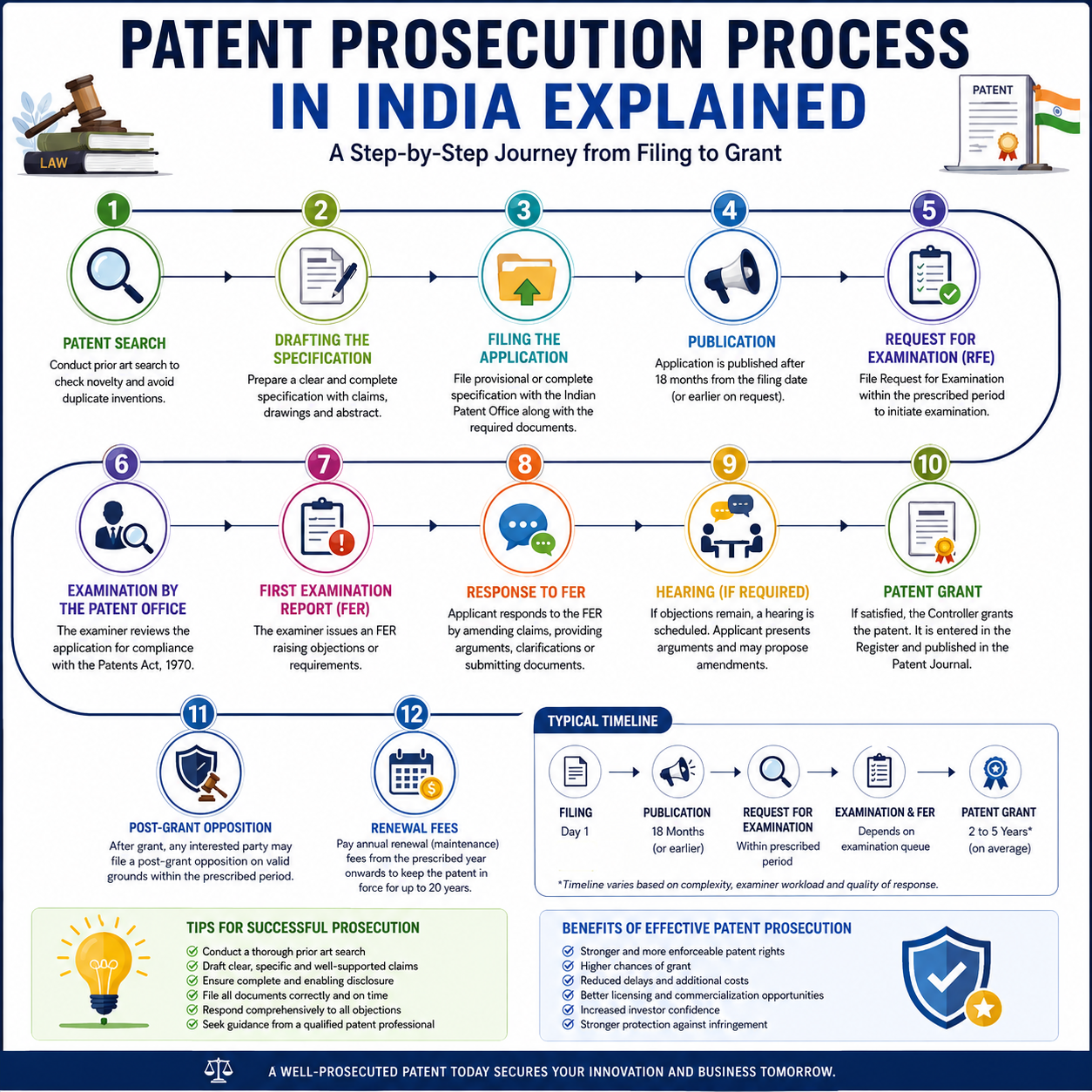
Step-by-Step Patent Prosecution Process in India
Step 1: Patent Search (Recommended)
Although not mandatory, conducting a patent search before filing helps determine whether the invention is already known.
A prior art search identifies:
- Existing patents
- Published patent applications
- Scientific journals
- Technical publications
Benefits include:
- Avoiding duplicate inventions
- Improving patent drafting
- Reducing chances of rejection
- Saving time and filing costs
Step 2: Drafting the Patent Specification
The quality of the patent specification significantly affects prosecution success.
The specification should clearly describe:
- Title of the invention
- Technical field
- Background
- Existing problems
- Summary of invention
- Detailed description
- Drawings
- Patent claims
- Abstract
The claims define the legal protection and must be carefully drafted.
Step 3: Filing the Patent Application
The application is filed electronically or physically with the Indian Patent Office.
Types of applications include:
Provisional Application
Filed when the invention is still under development.
Advantages:
- Secures an early priority date
- Provides 12 months to file the complete specification
Complete Specification
Contains the complete technical disclosure and claims.
Required documents generally include:
- Form 1
- Form 2
- Form 3 (if applicable)
- Form 5
- Power of Attorney (when filed through a patent agent)
- Drawings
- Abstract
Step 4: Publication of the Patent Application
Normally, every patent application is published after 18 months from the filing or priority date.
Publication allows the public to view the application.
Early Publication
Applicants can request early publication using the prescribed form.
Benefits:
- Faster processing
- Earlier examination eligibility
- Earlier enforceable rights after grant
Step 5: Request for Examination (RFE)
Filing a patent application alone does not initiate examination.
The applicant must file a Request for Examination (RFE) within the prescribed statutory period. Without this request, the application will not proceed to examination.
The Patent Office assigns the application to an examiner only after receiving the examination request.
Step 6: Examination by the Patent Office
The patent examiner reviews whether the invention satisfies the requirements under the Patents Act, 1970.
The examiner checks:
- Novelty
- Inventive step
- Industrial applicability
- Patentable subject matter
- Sufficiency of disclosure
- Clarity of claims
- Compliance with legal requirements
Step 7: First Examination Report (FER)
If the examiner identifies issues, the Patent Office issues a First Examination Report (FER).
The FER may include objections related to:
- Lack of novelty
- Obviousness
- Non-patentable subject matter
- Lack of clarity
- Insufficient disclosure
- Formal documentation defects
- Incorrect claim drafting
Receiving an FER is common and does not mean the application will be rejected.
Step 8: Responding to the FER
The applicant must submit a detailed response addressing all objections within the prescribed time.
The response may involve:
- Amending claims
- Clarifying technical features
- Providing legal arguments
- Submitting supporting documents
- Correcting formal deficiencies
A well-prepared response can significantly improve the chances of patent grant.
Step 9: Hearing (If Required)
If objections remain unresolved after the written response, the Controller may schedule a hearing.
During the hearing:
- The applicant or patent agent presents arguments.
- Technical and legal issues are discussed.
- Additional amendments may be proposed.
- The Controller evaluates whether the objections have been satisfactorily addressed.
Step 10: Patent Grant
If the Controller is satisfied that all legal requirements have been met, the patent is granted.
Upon grant:
- The patent is entered into the Patent Register.
- The grant is published in the Patent Journal.
- The patentee receives exclusive rights to make, use, sell, license, and commercialize the invention in India.
A patent in India generally remains valid for 20 years from the filing date, subject to payment of renewal fees.
Step 11: Post-Grant Opposition
After the patent is granted, interested parties may challenge its validity through post-grant opposition on grounds specified under the Patents Act.
Common grounds include:
- Lack of novelty
- Obviousness
- Wrongful obtaining
- Insufficient disclosure
- Non-patentable subject matter
If an opposition is filed, the Patent Office examines the challenge before reaching a final decision.
Step 12: Renewal Fees
To keep a patent in force, annual renewal (maintenance) fees must be paid from the prescribed year onward until the patent’s expiry.
Failure to pay renewal fees can result in the patent lapsing.
Typical Timeline of Patent Prosecution in India
| Stage | Approximate Timeline |
|---|---|
| Patent Filing | Day 1 |
| Publication | 18 months (or earlier on request) |
| Request for Examination | Within the prescribed statutory period |
| Examination | Depends on examination queue |
| First Examination Report | After examination |
| FER Response | Within the prescribed time |
| Hearing (if required) | Varies |
| Patent Grant | After successful prosecution |
The overall duration may range from 2 to 5 years, depending on the complexity of the invention, examination workload, and the quality of responses submitted during prosecution.
Common Reasons for Patent Application Rejection
Patent applications may face rejection due to:
- Lack of novelty
- Obvious or non-inventive subject matter
- Non-patentable inventions under Indian law
- Poor claim drafting
- Insufficient technical disclosure
- Failure to respond adequately to examination reports
- Missed statutory deadlines
- Lack of industrial applicability
Many of these issues can be minimized through careful drafting and timely compliance.
Tips for a Successful Patent Prosecution
- Conduct a comprehensive prior art search before filing.
- Draft clear and well-supported patent claims.
- Ensure the specification fully describes the invention.
- File all required forms correctly and on time.
- Monitor statutory deadlines carefully.
- Respond comprehensively to examination reports.
- Seek assistance from a qualified patent professional when needed.
Benefits of Effective Patent Prosecution
A well-managed prosecution process offers several advantages:
- Stronger and more defensible patent rights
- Increased likelihood of patent grant
- Reduced prosecution delays
- Better licensing and commercialization opportunities
- Enhanced investor confidence
- Improved protection against infringement
Frequently Asked Questions (FAQs)
1. What is patent prosecution in India?
Patent prosecution is the process of obtaining a patent from the Indian Patent Office, beginning with filing the application and ending with the grant or rejection of the patent.
2. How long does patent prosecution take in India?
The process generally takes 2 to 5 years, depending on factors such as examination timelines, the complexity of the invention, and the applicant’s responses to official objections.
3. Is receiving a First Examination Report (FER) a rejection?
No. The FER is a routine part of the examination process that outlines objections or requirements to be addressed before a patent can be granted.
4. Can patent claims be amended during prosecution?
Yes. Claims may be amended to overcome objections, provided the amendments comply with the provisions of the Indian Patents Act and do not introduce new matter beyond the original disclosure.
5. Is hiring a patent agent mandatory?
While it is not mandatory, working with a registered patent agent or patent attorney can improve the quality of the application and responses, helping to navigate the prosecution process more effectively.
Conclusion
The patent prosecution process in India is a structured legal procedure designed to ensure that only inventions meeting the statutory requirements receive patent protection. From filing and publication to examination, responding to objections, and ultimately securing a patent grant, each stage requires careful planning and compliance.
By understanding the prosecution process, maintaining timely communication with the Patent Office, and preparing well-drafted applications and responses, inventors and businesses can improve their chances of obtaining robust patent protection. A successfully prosecuted patent not only safeguards innovation but also strengthens a company’s competitive position, supports commercialization, and enhances long-term business value.

Recent Posts
Patent Prosecution Process in India

Can AI-Generated Inventions Be Patented in India?