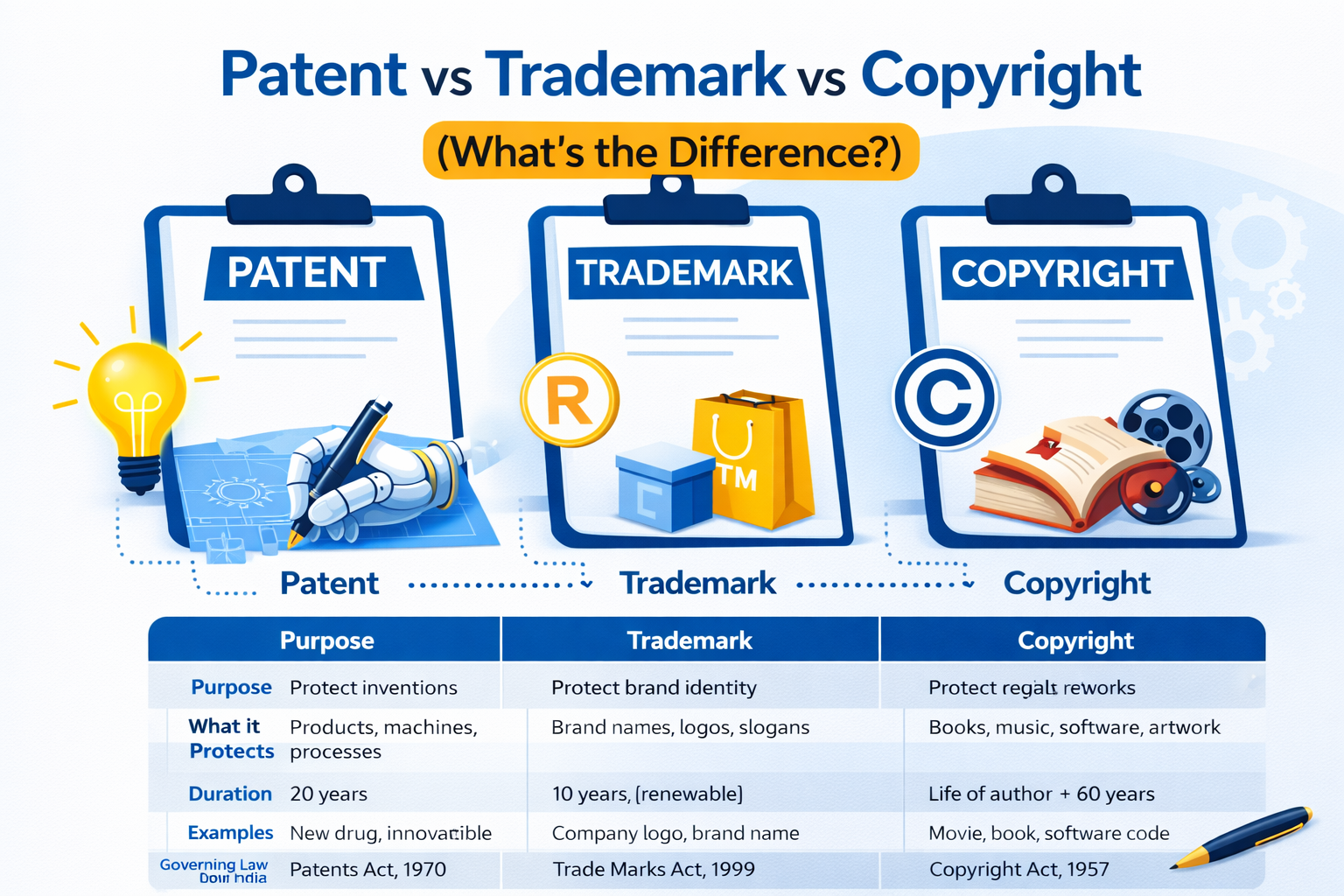
Patent vs Trademark vs Copyright: What’s the Difference?
For startups, entrepreneurs, and inventors in India, protecting intellectual property is essential for long-term success. When you create a new invention, brand, or creative work, you need legal protection to prevent others from copying or using it without permission.
This is where intellectual property rights such as patents, trademarks, and copyrights come into play. Each of these protections serves a different purpose and safeguards different types of creations.
Many business owners often get confused about the difference between these three. Understanding when to use patent registration in India, trademark registration in India, or copyright protection in India is crucial for protecting your business assets.
In this guide, we will explain the differences between patents, trademarks, and copyrights in simple terms so you can decide which type of protection is right for your business.
What is a Patent?
A patent is a legal right granted to an inventor that gives them exclusive ownership of an invention for a specific period.
In India, patents are governed by the Patents Act, 1970 and administered by the Indian Patent Office.
When a patent is granted, the inventor gets exclusive rights to:
- Make the invention
- Use the invention
- Sell or license the invention
No one else can use the invention without the patent holder’s permission.
Duration of Patent Protection
A patent in India remains valid for 20 years from the filing date.
Examples of Patentable Inventions
Some common examples include:
- A new mobile battery technology
- A medical device for early disease detection
- A new manufacturing process
- Innovative AI or machine-learning technology
For innovators and startups, patent registration in India helps protect unique technologies and provides a strong competitive advantage.
What is a Trademark?
A trademark protects the identity of a brand. It helps customers recognize and distinguish one business from another.
In India, trademarks are governed by the Trade Marks Act, 1999.
A trademark can include:
- Brand names
- Logos
- Symbols
- Taglines
- Product packaging
Duration of Trademark Protection
A trademark is valid for 10 years, but it can be renewed indefinitely as long as the business continues to use it.
Examples of Trademarks
Examples include:
- A company name like Flipkart
- A logo used by a brand
- A tagline like “Just Do It”
- A unique product label
For businesses, trademark registration in India is essential to protect brand identity and prevent competitors from using similar names or logos.
What is Copyright?
Copyright protects original creative works such as artistic, literary, and digital content.
In India, copyright protection is governed by the Copyright Act, 1957.
Copyright applies to creations such as:
- Books
- Music
- Films
- Photography
- Software code
- Website content
Unlike patents or trademarks, copyright protection begins automatically when the work is created, although official registration strengthens legal protection.
Duration of Copyright Protection
In India, copyright protection typically lasts for 60 years after the creator’s death.
Examples of Copyrighted Works
Examples include:
- A novel written by an author
- A music composition
- A film or documentary
- Website articles or blog content
- Computer software
Businesses that produce digital content or software often rely on copyright protection in India to safeguard their intellectual assets.
Patent vs Trademark vs Copyright: Key Differences
Although patents, trademarks, and copyrights all protect intellectual property, they serve different purposes.
Here is a simple comparison:
| Feature | Patent | Trademark | Copyright |
|---|---|---|---|
| Purpose | Protect inventions | Protect brand identity | Protect creative works |
| What it Protects | Products, machines, processes | Brand names, logos, slogans | Books, music, software, artwork |
| Duration | 20 years | 10 years (renewable) | Life of author + 60 years |
| Examples | New drug formula, innovative machine | Company logo, brand name | Movie, book, website content |
| Governing Law in India | Patents Act, 1970 | Trade Marks Act, 1999 | Copyright Act, 1957 |
Understanding these differences helps businesses choose the correct protection for their intellectual property.
Real-World Examples
To make the differences clearer, let’s look at real-world scenarios.
Example 1: Technology Startup
A startup develops a new AI-powered medical device.
- The technology can be protected through patent registration in India.
- The brand name of the product can be protected through trademark registration in India.
Example 2: Clothing Brand
A clothing brand launches a new fashion label.
- The brand name and logo are protected through trademarks.
- Unique fashion design patterns may also be protected through design rights.
Example 3: Content Creator
A YouTuber creates original videos and music.
- Their videos, scripts, and music are protected through copyright protection in India.
When Should a Business Use Patent, Trademark, or Copyright?
Startups and entrepreneurs often need more than one type of intellectual property protection.
Here’s when each protection is most useful.
When to Use Patent Protection
Choose patent protection when you create:
- A new product
- A unique machine
- A manufacturing process
- Innovative technology
For example, a startup creating a new renewable energy device should apply for patent registration in India.
When to Use Trademark Protection
Trademarks are important when you want to protect:
- Brand names
- Logos
- Business identity
- Product packaging
Every business that wants to build a recognizable brand should consider trademark registration in India.
When to Use Copyright Protection
Copyright is useful when you create:
- Books or articles
- Music and films
- Software code
- Photography
- Website content
Creative professionals and digital businesses rely on copyright protection in India to protect their original work.
Why Intellectual Property Protection is Important
Protecting intellectual property offers several business advantages.
1. Legal Protection
It prevents competitors from copying your invention, brand, or creative work.
2. Business Value
Intellectual property increases the value of your company.
3. Competitive Advantage
Protected innovations give businesses a unique position in the market.
4. Revenue Opportunities
You can license or sell your intellectual property rights.
For startups in India, securing intellectual property early can lead to better funding opportunities and long-term growth.
Frequently Asked Questions (FAQ)
1. Can a startup register both a patent and a trademark?
Yes. A startup can protect its technology through patents and its brand name through trademarks.
2. Is copyright registration mandatory in India?
Copyright protection exists automatically when a work is created. However, registration provides stronger legal evidence in case of disputes.
3. How long does patent registration take in India?
Patent approval usually takes 3 to 5 years, depending on examination and complexity.
4. Can a logo be patented?
No. Logos are protected through trademark registration, not patents.
5. Which intellectual property protection is best for startups?
It depends on the business. Most startups use a combination of patent registration in India, trademark registration in India, and copyright protection in India.
Protect Your Intellectual Property Today
If you have created an innovative product, built a unique brand, or produced original content, protecting it is essential for your business success.
Our intellectual property experts can help you with:
- Patent registration in India
- Trademark registration in India
- Copyright protection in India
- Complete IP filing and legal support
🚀 Get a Free Consultation Today
Contact our experts to protect your invention, brand, or creative work with professional IP registration services in India.

Recent Posts
Patent Prosecution Process in India

Can AI-Generated Inventions Be Patented in India?