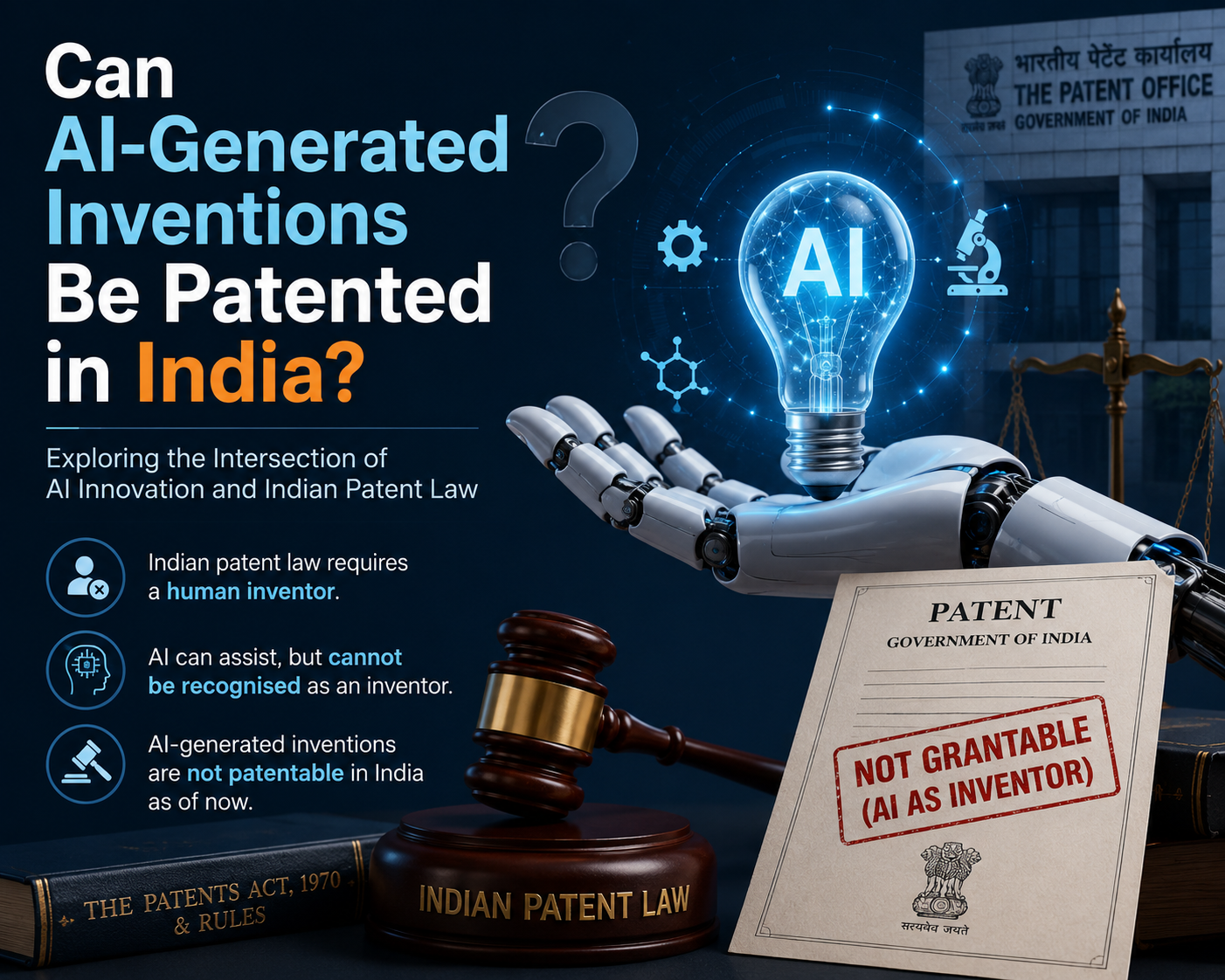
Can AI-Generated Inventions Be Patented in India?
Artificial Intelligence is transforming industries across the world. From healthcare diagnostics and autonomous vehicles to fintech automation and smart manufacturing, AI systems are now capable of generating solutions that once required human intelligence. As AI technology becomes more advanced, one major legal question continues to grow in importance: Can AI-generated inventions be patented in India?
This question has become highly relevant for Indian startups, technology companies, researchers, software developers, and patent professionals. Businesses investing heavily in machine learning, generative AI, neural networks, and automation want to secure intellectual property rights over their innovations. However, Indian patent law was originally drafted in an era when inventions were assumed to be created only by humans.
Today, AI tools can independently generate technical outputs, optimize designs, write code, discover drug compounds, and create engineering solutions with minimal human intervention. This creates legal uncertainty regarding inventorship, ownership, and patent eligibility.
In this detailed guide, we will explore:
- AI patents in India
- Patentability of AI inventions
- AI-generated inventions vs AI-assisted inventions
- Section 3(k) of the Indian Patent Act
- The DABUS patent case
- Whether AI can be named as an inventor in India
- Patent filing strategies for AI innovations
- Global legal developments in AI patent law
- Future scope of AI patents in India
This article is written specifically for the Indian legal and business ecosystem and follows Google E-E-A-T principles to provide trustworthy, expert-level guidance.
Understanding AI-Generated Inventions
Before discussing Indian patent law, it is important to understand what AI-generated inventions actually mean.
What Is an AI-Generated Invention?
An AI-generated invention is an invention created autonomously by an Artificial Intelligence system without substantial human contribution to the inventive concept.
Examples may include:
- AI discovering a new pharmaceutical compound
- Machine learning software designing a mechanical component
- Generative AI developing optimized industrial systems
- AI creating a new data compression method
In such situations, humans may provide the training data or computational environment, but the final inventive idea may originate from the AI system itself.
What Is an AI-Assisted Invention?
AI-assisted inventions are different.
In AI-assisted inventions, humans remain the primary inventors while AI tools help during the research or development process.
Examples include:
- Engineers using AI for product optimization
- Doctors using AI to identify treatment patterns
- Researchers using machine learning models for analysis
- Developers using AI coding tools during software creation
In these cases, human intelligence still drives the inventive concept.
This distinction is extremely important under Indian patent law because the legal system currently recognizes only human inventors.
AI Patents in India: Current Legal Framework
India does not have a separate Artificial Intelligence patent law. AI inventions are governed under the existing framework of the Indian Patents Act, 1970.
Several provisions become relevant when discussing AI innovation patentability.
Section 3(k) and AI Patents in India
One of the most important provisions affecting AI software patent India applications is Section 3(k) of the Indian Patents Act.
What Does Section 3(k) Say?
Section 3(k) states that the following are not patentable:
“A mathematical or business method or a computer programme per se or algorithms.”
This provision creates significant challenges for AI patent filing India applications because many AI technologies involve:
- Algorithms
- Machine learning models
- Neural networks
- Data processing systems
- Software implementations
Does Section 3(k) Completely Ban AI Patents?
No.
Section 3(k) does not completely prohibit AI patents in India. Instead, it restricts patents for software or algorithms “per se.”
Indian Patent Office guidelines and judicial interpretations suggest that AI inventions may still be patentable if they demonstrate:
- Technical effect
- Technical contribution
- Hardware integration
- Industrial application
- Real-world technical advancement
This means AI-related inventions can receive patent protection if they go beyond abstract software or mathematical methods.
Patentability Criteria for AI Inventions in India
For an AI invention to qualify for patent protection in India, it must satisfy standard patentability requirements.
1. Novelty
The invention must be new and should not have been publicly disclosed anywhere in the world before filing.
For AI inventions, novelty may involve:
- New AI architectures
- Unique machine learning applications
- Innovative training techniques
- New technical systems powered by AI
Example
A machine learning system that predicts industrial equipment failure using a unique technical process may qualify as novel.
2. Inventive Step
The invention must involve a technical advancement or economic significance that is not obvious to a skilled person.
This is one of the most challenging requirements for AI software patent India applications because many AI techniques rely on existing algorithms.
Patent applicants must show:
- Improved technical performance
- Better efficiency
- Reduced computational load
- Enhanced industrial outcomes
Example
An AI-powered manufacturing system reducing energy consumption by 40% through a unique predictive mechanism may demonstrate inventive step.
3. Industrial Applicability
The invention must be capable of industrial use.
Most AI technologies easily satisfy this requirement because they are applied in sectors such as:
- Healthcare
- Manufacturing
- Finance
- Agriculture
- Automotive
- Telecommunications
4. Technical Effect
Technical effect is extremely important in computer related inventions India cases.
Indian patent authorities often examine whether the invention produces a measurable technical improvement.
Examples of Technical Effect
- Faster processing speed
- Improved cybersecurity
- Better image recognition accuracy
- Reduced memory usage
- Enhanced industrial automation
- Improved network efficiency
If the invention merely automates human activity without technical advancement, it may be rejected under Section 3(k).
Can AI Be Named as an Inventor in India?
Currently, Indian patent law does not recognize AI as a legal inventor.
Under the Indian Patents Act, the inventor is generally understood to be a natural person.
This means:
- AI systems cannot legally own patents
- AI cannot sign legal documents
- AI cannot transfer rights
- AI lacks legal personality
Therefore, patent applications in India must name human inventors.
The DABUS Patent Case and India’s Position
The global debate around AI inventorship became famous because of the DABUS case.
What Is DABUS?
DABUS stands for:
Device for the Autonomous Bootstrapping of Unified Sentience
It is an AI system developed by Dr. Stephen Thaler.
Patent applications were filed in multiple countries naming DABUS as the inventor.
What Happened Globally?
Different countries responded differently.
United States
The US Patent and Trademark Office rejected the application, stating that only natural persons can be inventors.
US courts later upheld this decision.
United Kingdom
The UK Intellectual Property Office also rejected DABUS inventorship.
The UK Supreme Court confirmed that AI cannot legally be named as an inventor.
Europe
The European Patent Office rejected the DABUS applications because the inventor must be human.
Australia
Australia briefly accepted AI inventorship in an early decision, but this was later overturned.
DABUS Patent Case India Perspective
India has not yet delivered a landmark judicial ruling directly on AI inventorship similar to DABUS.
However, based on the current legal framework:
- AI is unlikely to be recognized as an inventor
- Human inventors remain mandatory
- AI-generated inventions face legal uncertainty
Indian patent law still relies heavily on the concept of human creativity and legal ownership.
AI-Generated Inventions Patent India: Major Legal Challenges
The patentability of AI inventions creates several practical and legal issues.
1. Determining the Inventor
If AI autonomously creates an invention, who becomes the inventor?
Possible options include:
- AI developer
- AI user
- Company owner
- Data provider
- Research organization
Indian law currently does not clearly address this issue.
2. Section 3(k) Restrictions
Many AI innovations are algorithm-based.
Patent examiners may reject applications if they appear to be:
- Pure software
- Mathematical models
- Data processing methods
- Abstract algorithms
Therefore, drafting strategy becomes critical.
3. Lack of AI-Specific Patent Laws
India currently lacks dedicated legislation on AI intellectual property India matters.
Patent applicants must rely on traditional legal principles that may not fully accommodate autonomous AI systems.
4. Disclosure Challenges
Patent law requires full disclosure of the invention.
However, some AI systems operate as “black boxes,” making it difficult to explain:
- Decision-making logic
- Training processes
- Model reasoning
- Neural network behavior
This creates compliance difficulties during patent drafting.
Examples of Patentable AI Inventions in India
Certain AI innovations may qualify for patent protection if properly drafted.
Potentially Patentable AI Technologies
AI-Based Medical Devices
An AI system integrated with medical hardware that improves disease detection accuracy.
Industrial Automation Systems
Machine learning systems optimizing manufacturing processes with measurable technical effects.
Autonomous Vehicle Technologies
AI-enabled navigation systems improving vehicle safety and operational efficiency.
Cybersecurity Solutions
AI systems detecting network intrusions through unique technical mechanisms.
Smart Energy Management
AI systems controlling industrial power usage for efficiency improvement.
Examples of Non-Patentable AI Inventions
The following may face rejection under Section 3(k).
Likely Non-Patentable
- Pure AI algorithms
- Mathematical models
- Generic chatbots
- Data analysis methods without technical effect
- Business automation software
- Abstract machine learning models
Patent eligibility depends heavily on how the invention is presented and claimed.
AI Software Patent India: Drafting Strategy Matters
Patent drafting plays a crucial role in AI patent filing India applications.
Poorly drafted applications are often rejected under Section 3(k).
Best Practices for Drafting AI Patent Applications
Focus on Technical Effect
Explain how the invention solves a technical problem.
Avoid Pure Algorithm Claims
Claims should not merely describe mathematical formulas.
Include Hardware Integration
Mention sensors, processors, devices, industrial systems, or network infrastructure where applicable.
Describe Real-World Application
Show industrial utility and measurable improvement.
Provide Technical Architecture
Include system flowcharts, technical diagrams, and implementation details.
Practical Guidance for Startups and Businesses
Indian startups are increasingly developing AI-driven technologies.
To maximize patent protection, businesses should adopt a proactive strategy.
1. File Early
AI innovation moves rapidly.
Filing early helps prevent prior art issues and protects competitive advantage.
2. Maintain Documentation
Keep records of:
- Human contribution
- Research development
- AI training methods
- Technical improvements
- Experimental results
This may help establish inventorship and inventive step.
3. Combine Patents With Trade Secrets
Some AI technologies may be better protected through confidentiality rather than patent disclosure.
Hybrid IP strategies are often effective.
4. Conduct Patentability Searches
Before filing, businesses should evaluate:
- Existing patents
- Prior art databases
- International patent trends
- Competitor technologies
5. Work With Experienced Patent Professionals
AI inventions involve both legal and technical complexity.
Professional patent drafting significantly improves approval chances.
Machine Learning Patent India: Emerging Trends
Machine learning patent India filings are increasing rapidly in sectors such as:
- Fintech
- Healthcare
- Automotive
- Robotics
- Agriculture technology
- Smart cities
- Telecommunications
The Indian government is also encouraging AI innovation through initiatives like:
- Digital India
- IndiaAI Mission
- Startup India
- National AI strategies
As AI adoption expands, patent filings related to machine learning are expected to grow substantially.
Global Perspective on AI and Patent Law
Countries worldwide are struggling with similar legal questions regarding AI-generated inventions.
United States
The US allows patents for AI-related inventions but requires human inventorship.
Software patents may qualify if they demonstrate technical improvement.
European Union
Europe adopts a stricter approach toward software patents but permits AI patents involving technical contribution.
China
China is rapidly strengthening AI patent protection and encouraging AI innovation filings.
Chinese patent authorities increasingly support AI-related inventions with industrial application.
United Kingdom
The UK currently rejects AI inventorship but continues exploring future reforms.
What India Can Learn From Global Trends
India may eventually introduce:
- AI-specific patent guidelines
- Clarification on inventorship
- AI disclosure standards
- New examination frameworks
Global legal developments will likely influence Indian policy over time.
Future Scope of AI Patents in India
The future of Artificial Intelligence patent law India is highly dynamic.
Several trends are expected in the coming years.
1. Increase in AI Patent Filings
Indian startups and multinational corporations are investing heavily in AI R&D.
This will lead to a surge in:
- AI patent filing India applications
- Machine learning patent India filings
- AI software patent India registrations
2. Evolution of Patent Examination Standards
The Indian Patent Office may issue clearer guidelines specifically for AI innovation patentability.
3. Greater Focus on Technical Effect
Future patent decisions will likely emphasize measurable technical contribution.
4. Possible Legal Reforms
India may eventually reconsider:
- Inventorship definitions
- AI-generated outputs
- Ownership structures
- Computer related inventions India framework
However, such reforms may take time.
5. Growth of AI Litigation
As AI patents increase, disputes involving infringement, ownership, and licensing may also grow.
Businesses should prepare for stronger IP enforcement strategies.
How Indian Businesses Can Build Strong AI Patent Portfolios
Companies working in AI should adopt a structured intellectual property strategy.
Key Steps
| Strategy | Importance |
|---|---|
| Early patent filing | Prevents competitor copying |
| Technical documentation | Supports patentability |
| Patent landscape analysis | Reduces infringement risks |
| International filing | Expands protection globally |
| Strong claim drafting | Improves approval chances |
| IP audits | Identifies valuable innovations |
Internal Linking Suggestions for SEO
To improve website SEO and user engagement, link this article internally with related service pages such as:
- Patent Filing Services
- Patent Drafting Services
- Patent Prosecution Services
- Patent Search Services
- Software Patent Registration
- Intellectual Property Consulting
- Startup IP Protection Services
These internal links improve topical authority and search engine crawling.
Common Mistakes in AI Patent Filing India
Many AI patent applications fail because of avoidable errors.
Frequent Mistakes
- Describing only algorithms
- Ignoring technical effect
- Weak patent claims
- Insufficient disclosure
- Lack of novelty analysis
- Poor claim drafting
- Filing too late after public disclosure
Proper patent strategy can significantly reduce rejection risk.
Why AI Patent Protection Matters
Patent protection offers several business advantages.
Benefits of AI Patents
- Competitive advantage
- Investor confidence
- Licensing opportunities
- Increased company valuation
- Stronger market position
- Technology commercialization
- Legal protection against copying
For startups especially, patents can become valuable business assets.
Conclusion
The question “Can AI-generated inventions be patented in India?” does not yet have a completely straightforward answer.
Under current Indian patent law, AI itself cannot be recognized as an inventor. Patent applications must identify human inventors, and AI-generated inventions face significant legal uncertainty. However, AI-assisted inventions can still receive patent protection if they satisfy the standard requirements of novelty, inventive step, industrial applicability, and technical effect.
Section 3(k) remains one of the biggest challenges for AI software patent India applications. Nevertheless, properly drafted AI inventions demonstrating real technical contribution can still qualify for patents in India.
As Artificial Intelligence continues to evolve, Indian patent law will likely adapt to address emerging questions around inventorship, ownership, and autonomous innovation. Businesses, startups, and researchers investing in AI technologies should adopt strong intellectual property strategies now to remain competitive in the future.
The growing importance of AI patents in India makes professional patent drafting, prosecution, and legal guidance more important than ever.
FAQs: AI Patents in India
1. Can AI-generated inventions be patented in India?
Currently, Indian patent law does not clearly recognize AI-generated inventions without human inventorship. Human inventors are still required for patent applications.
2. Can AI be named as an inventor in India?
No. Indian patent law presently recognizes only natural persons as inventors.
3. What is Section 3(k) in AI patent law India?
Section 3(k) excludes computer programs per se, algorithms, and mathematical methods from patentability.
4. Are AI software patents allowed in India?
Yes, in some cases. AI software may be patentable if it demonstrates technical effect and industrial application beyond a mere algorithm.
5. What is the DABUS patent case?
The DABUS case involved an AI system being named as an inventor in patent applications filed globally. Most jurisdictions, including the US, UK, and Europe, rejected AI inventorship.
6. What are examples of patentable AI inventions?
Examples include AI-powered medical devices, industrial automation systems, cybersecurity technologies, and autonomous vehicle innovations.
7. Can machine learning models be patented in India?
Pure machine learning algorithms may not be patentable, but practical technical implementations with industrial application may qualify.
8. Why do AI patent applications get rejected in India?
Common reasons include Section 3(k) objections, lack of inventive step, insufficient technical effect, and poor claim drafting.
9. Is patent protection important for AI startups?
Yes. AI patents help startups secure funding, protect technology, increase valuation, and build competitive advantage.
10. How can businesses improve AI patent approval chances?
Businesses should focus on technical effect, strong patent drafting, hardware integration, novelty analysis, and professional IP guidance.

Recent Posts
Patent Prosecution Process in India
Can AI-Generated Inventions Be Patented in India?