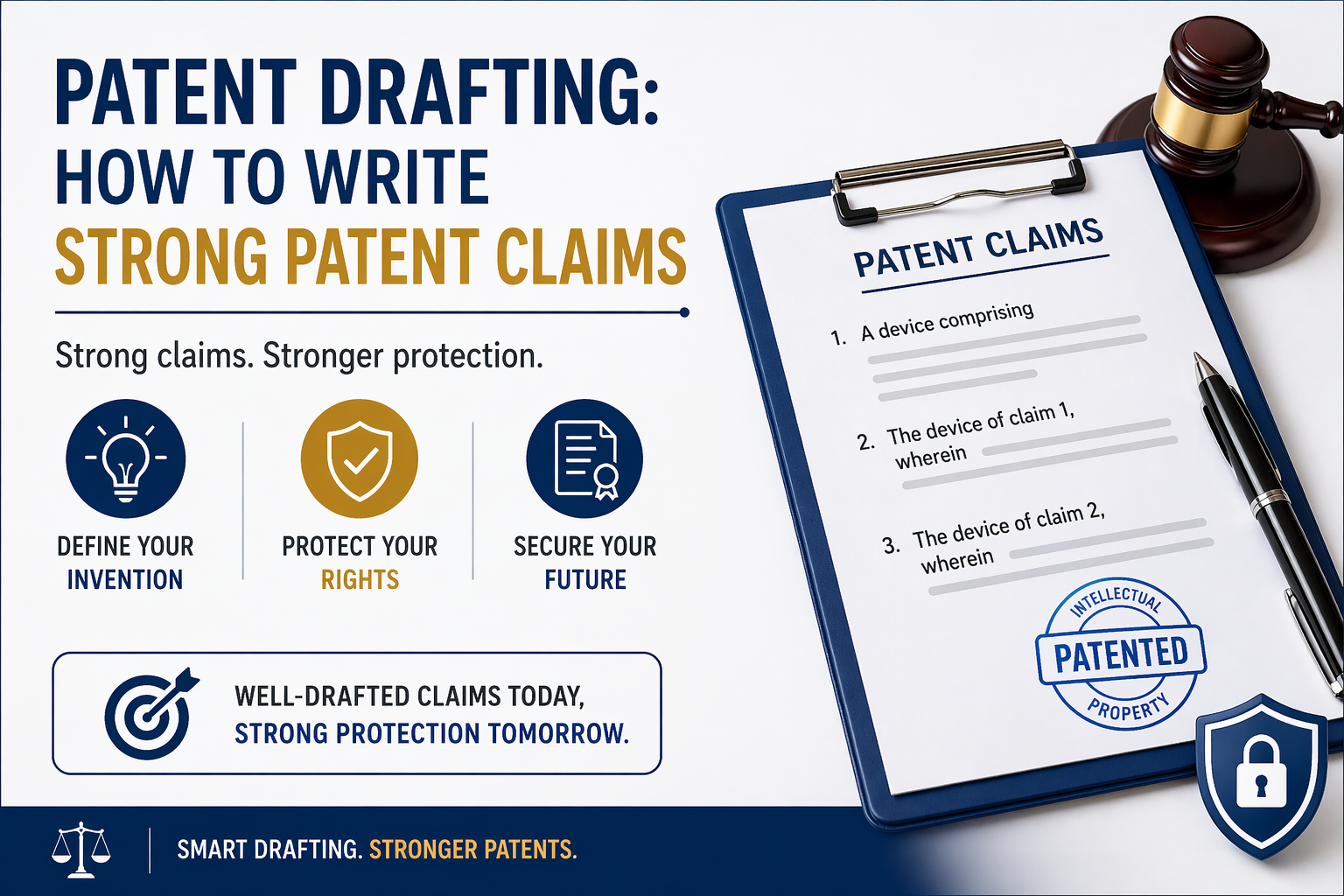
Patent Drafting: How to Write Strong Patent Claims
Introduction
In the world of innovation, securing your idea is just as important as creating it. This is where Patent Drafting plays a crucial role. A well-drafted patent not only protects your invention but also determines the extent of legal rights you can enforce. In India, where startups and innovation are growing rapidly, understanding how to write patent claims effectively can make the difference between a granted patent and a rejected application.
Patent drafting is not just about describing an invention—it’s about defining its boundaries with precision and clarity. At the heart of every patent lies its Patent Claims, which legally define the scope of protection.
What Are Patent Claims and Why Are They Important?
Patent Claims are the most critical part of a patent application. They define the legal boundaries of your invention—what is protected and what is not.
Why Patent Claims Matter:
- They determine the scope of protection
- They are used in patent infringement cases
- They influence whether your patent will be granted or rejected
Even if your invention is innovative, poorly written claims can result in weak protection or complete rejection.
Types of Patent Claims
Independent Claims
Independent claims stand on their own and define the invention in its broadest form.
Example:
A device comprising a sensor, a processor, and a communication module configured to transmit data.
Dependent Claims
Dependent claims refer back to an independent claim and add further limitations.
Example:
The device of claim 1, wherein the sensor is a temperature sensor.
Multiple Dependent Claims (Less common in India)
These refer to more than one claim but are used cautiously due to fee implications.
Step-by-Step Guide: How to Write Patent Claims
Step 1: Understand Your Invention Thoroughly
Before drafting, break down your invention into:
- Core features
- Optional features
- Technical advantages
Step 2: Identify Novel Elements
Focus on what makes your invention unique compared to existing technologies (prior art).
Step 3: Start with Broad Claims
Draft independent claims as broadly as possible without overlapping prior art.
Step 4: Add Narrower Dependent Claims
Include variations and specific embodiments to strengthen protection.
Step 5: Use Proper Claim Structure
A typical claim includes:
- Preamble (introduction)
- Transitional phrase (e.g., “comprising”)
- Body (technical features)
Step 6: Review and Refine
Ensure claims are:
- Clear
- Supported by the description
- Legally enforceable
Best Practices for Strong Patent Drafting
Clarity and Precision
Avoid vague terms like “better,” “fast,” or “improved” without definition.
Use of Proper Language
Use terms like:
- “Comprising” (open-ended)
- “Consisting of” (closed-ended)
Maintain Broad Yet Defensible Scope
Too broad → risk of rejection
Too narrow → weak protection
Consistency in Terminology
Use the same terms throughout the document to avoid confusion.
Support in Description
Every claim must be backed by the detailed description.
Common Mistakes to Avoid
- Writing overly broad claims without support
- Using ambiguous or unclear language
- Ignoring prior art
- Inconsistent terminology
- Lack of technical detail
- Copying claims from other patents
These mistakes can lead to objections or rejection by the Indian Patent Office.
Patent Drafting in India: Practical Tips
When it comes to Patent drafting in India, applicants must follow the rules and guidelines set by the Indian Patent Office under the Patents Act, 1970.
Key Tips:
- Ensure claims are clear and succinct (Section 10 of the Act)
- Avoid non-patentable subject matter (Section 3 & 4)
- Include proper technical disclosure
- Respond effectively to First Examination Report (FER) objections
- Use professional formatting and structure
Real-World Example of a Patent Claim
Simple Example:
Independent Claim:
A water purification system comprising a filtration unit, a UV treatment chamber, and a storage tank.
Dependent Claim:
The system of claim 1, wherein the filtration unit includes an activated carbon filter.
This example shows how broad protection is established first, then refined with specific features.
How Professional Patent Drafting Services Help
Hiring experts for Patent Drafting can significantly improve your chances of success.
Benefits:
- Expert knowledge of patent laws
- Strong and enforceable claim drafting
- Reduced risk of objections
- Faster approval process
- Strategic protection of your invention
Professional services ensure your patent is not just filed—but protected effectively.
Conclusion
Patent Drafting is both a technical and legal skill that directly impacts the strength of your intellectual property. Writing strong Patent Claims requires precision, strategy, and a deep understanding of patent law.
If you want to secure your invention and maximize its commercial value, investing in expert patent drafting is a smart move. Don’t leave your innovation vulnerable—get professional help and ensure your patent stands strong in the market.
FAQs
1. What is the most important part of Patent Drafting?
The most important part is the Patent Claims, as they define the legal protection of your invention.
2. How many claims should a patent have?
There is no fixed number, but a balanced mix of broad and narrow claims is recommended.
3. Can I write patent claims myself?
Yes, but it is risky. Poorly drafted claims can lead to rejection or weak protection.
4. What is the difference between independent and dependent claims?
Independent claims stand alone, while dependent claims add specific limitations to them.
5. How long does patent drafting take in India?
It depends on the complexity of the invention, but typically ranges from a few days to a few weeks.
Author: Patent Registration India Team

Recent Posts
Patent Prosecution Process in India

Can AI-Generated Inventions Be Patented in India?