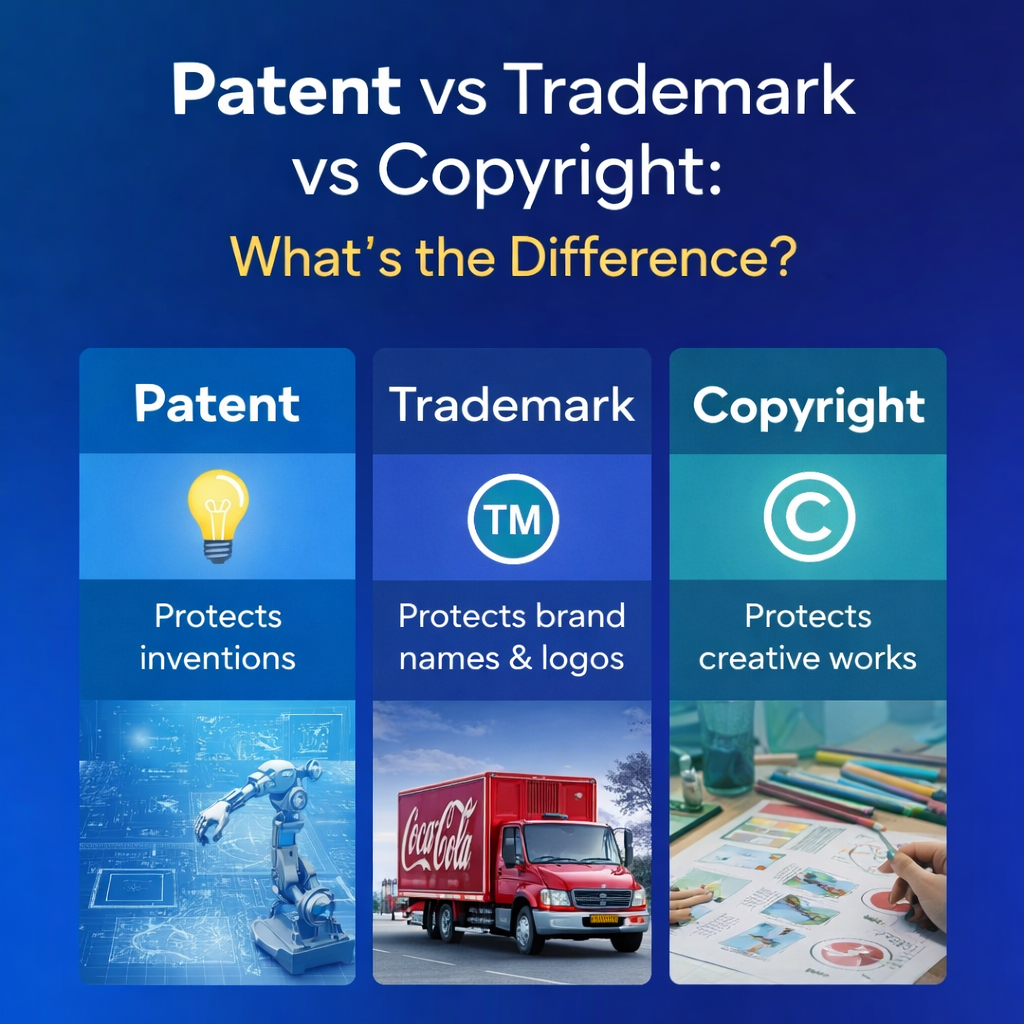
Patent, Trademark, or Copyright: Which Protection Do You Need in India?
Understanding intellectual property (IP) is essential for anyone building a business in India. Whether you are a startup founder, entrepreneur, or inventor, your ideas, brand, and creative work are valuable assets. Protecting them legally can help you grow faster, avoid disputes, and build trust in the market.
However, many people get confused between patents, trademarks, and copyrights. Each serves a different purpose and protects different types of creations.
If you are planning patent registration in India, trademark registration in India, or copyright registration in India, this guide will help you understand the key differences in a simple and clear way.
What is a Patent?
A patent is a legal right granted to an inventor for a new invention. It gives the inventor exclusive rights to use, make, and sell the invention.
Key Features of a Patent
- Protects inventions and innovations
- Provides exclusive rights for 20 years
- Prevents others from copying the invention
- Can be licensed or sold
What Can Be Patented?
To qualify for patent registration in India, an invention must:
- Be new (novel)
- Have an inventive step
- Be useful (industrial applicability)
Examples of Patents
- A new medical device
- A unique software-based system with technical application
- A new machine or manufacturing process
- An innovative battery technology
Patents are ideal for startups working on technology, products, or processes.
What is a Trademark?
A trademark protects your brand identity. It helps customers recognize your business and distinguish it from others.
Key Features of a Trademark
- Protects brand names, logos, and slogans
- Can be renewed every 10 years
- Builds brand recognition
- Prevents others from using similar marks
What Can Be Trademarked?
- Business name
- Logo
- Tagline
- Product name
- Packaging design
Examples of Trademarks
- A company logo
- A brand name like a startup’s app name
- A tagline used in marketing campaigns
For businesses, trademark registration in India is essential to protect branding and market identity.
What is Copyright?
Copyright protects original creative works such as content, music, software, and designs.
Key Features of Copyright
- Protects creative and artistic work
- Starts automatically when the work is created
- Lasts for lifetime of the creator + 60 years
- Provides rights to reproduce and distribute content
What Can Be Copyrighted?
- Books and articles
- Music and videos
- Software code
- Website content
- Photographs and designs
Examples of Copyright
- A blog article
- A YouTube video
- Mobile app code
- Graphic designs
For creators and digital businesses, copyright registration in India adds strong legal proof of ownership.
Patent vs Trademark vs Copyright: Key Differences
Here is a simple comparison to help you understand the differences clearly:
| Feature | Patent | Trademark | Copyright |
|---|---|---|---|
| Purpose | Protect inventions | Protect brand identity | Protect creative work |
| What it Protects | Products, machines, processes | Names, logos, slogans | Content, music, software |
| Duration | 20 years | 10 years (renewable) | Life + 60 years |
| Examples | New technology, machine | Brand name, logo | Book, video, code |
| Applicable Law in India | Patents Act, 1970 | Trade Marks Act, 1999 | Copyright Act, 1957 |
Real-Life Examples for Better Understanding
Let’s break it down with simple real-world scenarios:
Example 1: Tech Startup
A startup creates a new AI-powered tool.
- The technology → protected by a patent
- The brand name → protected by a trademark
- The software code → protected by copyright
Example 2: E-commerce Brand
An online store launches a fashion brand.
- Brand name & logo → trademark
- Product photos & website content → copyright
Example 3: Content Creator
A YouTuber creates videos and music.
- Videos & scripts → copyright
- Channel name → trademark
When to Choose Patent, Trademark, or Copyright?
Choosing the right type of protection depends on what you want to protect.
Choose Patent Protection If:
- You created a new invention or product
- You developed a unique process or technology
- You want exclusive rights over innovation
Choose Trademark Protection If:
- You want to protect your brand name or logo
- You are building a business identity
- You want customers to recognize your brand
Choose Copyright Protection If:
- You create content, software, or media
- You produce creative or digital work
- You want to protect original expression
Which One Do You Need for Your Business?
Most businesses actually need a combination of all three.
For Startups
- Patent → for innovation
- Trademark → for brand identity
- Copyright → for website/app content
For Product-Based Businesses
- Patent → for product design or technology
- Trademark → for brand name
- Copyright → for marketing materials
For Digital Businesses
- Trademark → for brand name
- Copyright → for content and software
Simple Rule
- Innovation = Patent
- Brand = Trademark
- Content = Copyright
Using the right combination helps fully protect your business assets.
Why Intellectual Property Protection is Important
Protecting your intellectual property gives your business several advantages:
1. Legal Protection
Prevents others from copying your ideas or brand.
2. Business Growth
IP assets increase company valuation.
3. Competitive Advantage
You stand out in the market.
4. Revenue Opportunities
You can license or sell your IP rights.
5. Investor Attraction
Investors prefer businesses with protected IP.
This is why many startups invest early in patent registration in India, trademark registration in India, and copyright registration in India.
Frequently Asked Questions (FAQ)
1. Can I apply for patent, trademark, and copyright together?
Yes. If your business has innovation, branding, and content, you can apply for all three types of protection.
2. Which is the most important for startups?
It depends on your business. Most startups start with trademark registration in India, and then move to patents if they have unique technology.
3. Is copyright registration mandatory in India?
No, it is automatic. However, registration provides stronger legal proof in case of disputes.
4. How long does patent registration take in India?
Patent approval usually takes 3 to 5 years depending on the complexity.
5. Can a logo be patented?
No. A logo is protected through trademark registration, not a patent.
Get Expert Help for IP Registration in India
Understanding the difference between patents, trademarks, and copyrights is the first step. The next step is protecting your intellectual property correctly.
Whether you need:
- Patent registration in India
- Trademark registration in India
- Copyright registration in India
our experts are here to help you at every step.
🚀 Need help with patent or trademark registration? Get a free consultation with our experts today.
Protect your ideas, brand, and creativity with professional IP registration services in India.

Recent Posts
Patent Prosecution Process in India

Can AI-Generated Inventions Be Patented in India?