Claim Chart in Patent Law: Meaning and Importance
Introduction to Claim Chart in Patent Law
A claim chart in patent law is a structured document used to compare a patent claim with a product, process, or prior art. For startups, inventors, and businesses involved in patent registration in India, understanding claim charts is extremely important. It helps in identifying whether an invention is unique, whether it infringes an existing patent, and how strong a patent application is during the patent filing process in India.
What is a Claim Chart?
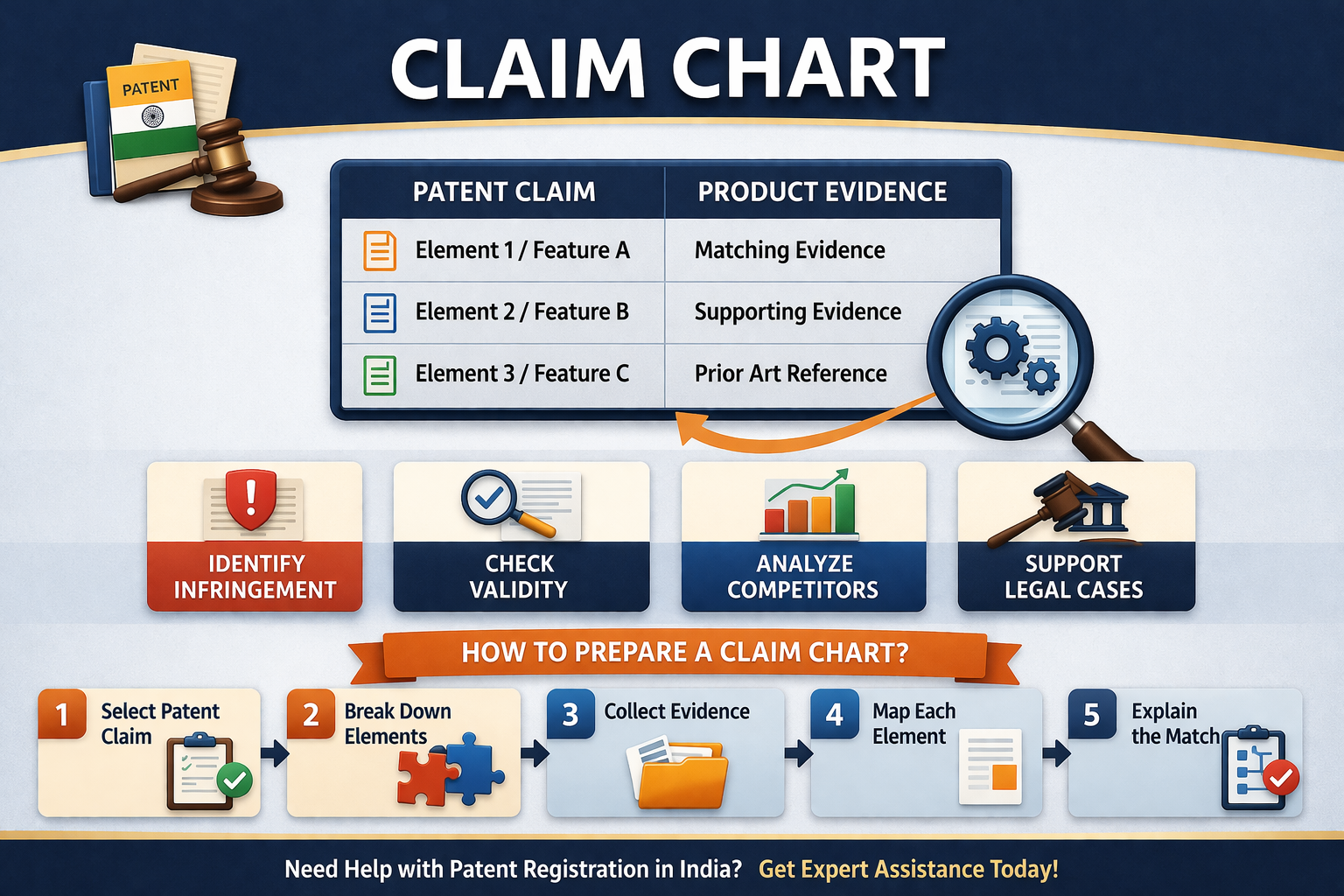
A claim chart is a side-by-side comparison that maps each element of a patent claim to a corresponding feature in a product or technology. In simple terms, it is a detailed table that shows whether all parts of a patent claim are present in a product.
Key Concept of Claim Mapping
Claim charting is also known as claim mapping, where:
- Each claim element is broken down
- Each element is matched with real-world evidence
- A clear explanation is provided
This process is widely used when analyzing how to register a patent in India and ensuring that the invention is truly unique.
Structure of a Claim Chart
Basic Format of a Claim Chart
A typical claim chart includes:
- Patent claim elements
- Product or prior art evidence
- Explanation of matching
This structured format simplifies complex patent language and makes it easier for legal and technical professionals to analyze patents during patent registration in India.
Why Do You Need a Claim Chart?
A claim chart is an essential tool in patent analysis, offering clarity, structure, and legal strength in multiple scenarios. Below are the key reasons why claim charts are widely used:
1. To Identify Patent Infringement
A claim chart plays a crucial role in determining whether a product or technology infringes on an existing patent. It systematically maps each element of a patent claim against the features of the accused product or process. When all elements of a claim are found in the product, it strongly indicates potential infringement. This structured comparison reduces ambiguity and provides a clear, evidence-based foundation for legal evaluation.
2. To Strengthen Patent Filing
During the patent drafting and filing process—especially in jurisdictions like India—claim charts help ensure that the invention is clearly distinguished from prior art. By comparing the proposed claims with existing patents, applicants can refine their claims to avoid overlap or duplication. This improves the overall quality, clarity, and defensibility of the patent application, increasing the likelihood of approval.
3. To Support Legal Cases
In patent litigation or disputes, claim charts serve as powerful visual and analytical tools. They present complex technical information in a structured, easy-to-understand format for judges, attorneys, and other stakeholders. By clearly showing how each claim element corresponds (or does not correspond) to a product, claim charts strengthen legal arguments and act as reliable supporting evidence in court proceedings.
4. To Analyze Competitors
Businesses often use claim charts as part of competitive intelligence and risk management strategies. By analyzing competitor patents and comparing them with their own products, companies can identify potential infringement risks before launching in the market. This proactive approach helps avoid costly legal disputes, guides product development decisions, and supports strategic innovation planning.
Importance of Claim Chart in Patent Registration in India for Stronger Protection and Better Approval Chances
Simplifies Complex Patent Claims
Patent claims are often highly technical and difficult to interpret, especially for individuals without a legal or engineering background. Claim charts simplify this complexity by breaking down lengthy claims into smaller, manageable elements. This structured approach makes it easier to understand, analyze, and evaluate each component of the invention.
Provides Strong Evidence
Claim charts replace assumptions with clear, organized, and verifiable proof. By mapping each claim element to corresponding product features or prior art, they create a solid evidentiary foundation. This is particularly important in patent enforcement, licensing discussions, and legal disputes.
Reduces Risk of Rejection
For individuals learning how to register a patent in India, claim charts act as a preventive tool. They help identify similarities with existing patents (prior art) early in the process, allowing applicants to refine their claims. This significantly reduces the likelihood of objections or rejection during examination.
Improves IP Strategy
Claim charts are not just legal tools—they are strategic assets. Businesses use them to strengthen their intellectual property (IP) portfolio, identify innovation gaps, and make informed decisions. This leads to better protection of inventions and a more competitive market position.
How to Prepare a Claim Chart
Step 1: Select the Patent Claim
Choose the most relevant claim, typically the independent claim, as it defines the core scope of the invention.
Step 2: Break Down the Claim
Divide the claim into smaller elements or limitations to enable precise comparison and analysis.
Step 3: Collect Evidence
Gather supporting materials such as:
- Product specifications
- Technical documents
- Website content
- Images or diagrams
Step 4: Map Each Element
Systematically match each claim element with the corresponding feature of the product or technology being analyzed.
Step 5: Add Explanation
Provide a clear and logical explanation showing how each claim element corresponds to the product. This strengthens clarity and credibility.
Example of a Claim Chart
Simple Claim Chart Format
| Claim Element | Product Feature |
|---|---|
| Battery system | Mobile battery |
| Charging unit | USB charger |
| Control system | Circuit board |
If all elements match, it may indicate potential patent infringement.
Common Mistakes in Claim Chart Preparation
Missing Claim Elements
Ignoring even a single claim element can weaken the entire analysis and lead to incorrect conclusions.
Weak Evidence
Relying on assumptions instead of concrete proof reduces the reliability of the claim chart.
Incorrect Interpretation
Misunderstanding patent language or claim scope can result in flawed mapping.
Lack of Expertise
Preparing an accurate claim chart requires both legal understanding and technical knowledge.
Tips for Creating a Strong Claim Chart
Use Clear Language
Ensure explanations are simple, precise, and easy to understand.
Include Visual Proof
Support your analysis with diagrams, screenshots, or product images for better clarity.
Map Every Element
Cover all claim elements thoroughly to avoid gaps in analysis.
Seek Expert Help
Professional guidance improves accuracy, strengthens arguments, and reduces risks.
Role of Claim Chart in Patent Filing Process in India
Although claim charts are not mandatory, they play a significant role in:
- Strengthening patent applications
- Avoiding duplication with existing patents
- Supporting long-term IP strategy
- Improving success rates in patent registration in India
For startups and inventors, claim charts are especially valuable in understanding the scope of their invention and minimizing legal risks.
Key Takeaways on Claim Chart Usage
A claim chart in patent law is a powerful analytical and strategic tool. It simplifies complex claims, provides structured and reliable evidence, and supports informed decision-making.
For anyone involved in patent registration in India, understanding and using claim charts is essential to protect innovations, avoid infringement risks, and build a strong intellectual property portfolio.
Get Expert Help for Patent Registration in India
If you want to protect your invention or need assistance with claim chart preparation, expert guidance can make a significant difference.
👉 Contact us today for a free consultation on patent registration in India and secure your innovation with professional support.
If you want, I can also optimize this for SEO (with keywords, meta description, and slug) or make it more blog-friendly or website-ready.

Recent Posts
Patent Prosecution Process in India

Can AI-Generated Inventions Be Patented in India?